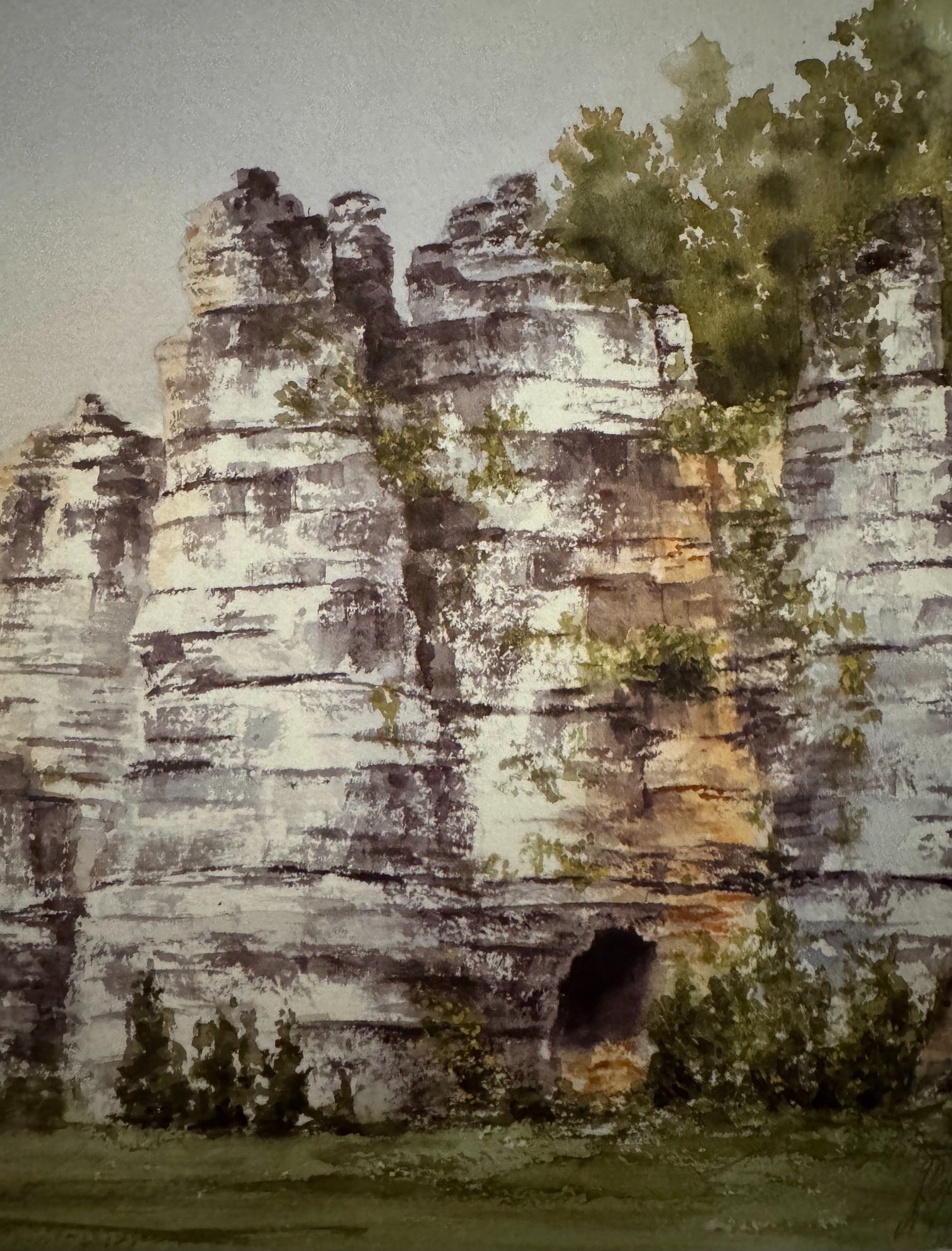
This is part of the Astroids series.
That Invisible Thread
Click, clack… Click, clack… Click, clack. The sound of my hiking poles striking hard rock as I navigated the trail. It was 9 PM, well past sunset. The forest was cool and the leaves danced to a gentle, refreshing breeze. It had been three hours since I set out, and I’d found myself in a state of trance. My arms and feet pushed forward with little effort, and I let my thoughts wander. I couldn’t see or hear the other runners, but I could feel someone was hot on my heels. It’s an odd feeling. I call it the sixth sense. It happens sometimes when walking down the street. I can tell there is someone behind me, even when I can’t see or hear them. As if we could feel the presence of others even when our eyes and ears are closed.
There is a word in Arabic that describes a much more intense variation of that feeling: “بتونس بيك” (Btoanas Beek). It is when you care for someone enough that you feel their physical presence with you, even when they aren’t around; and even when they are dead. It’s used in romantic contexts, but it could just as well describe how one feels about close friends or siblings. I think about that sometimes on these trails. Maybe that’s what the sixth sense really is. Some invisible thread, stranger-to-stranger echo of that same ancient wiring. The body registering a presence that the eyes haven’t confirmed yet.
That Narrow Space
Suddenly, my ears perked up. From a distance, I could hear music. Faint, but it was there. The third aid station; and just about time. I was dying for a bathroom break. I picked up my pace from a power hike to a gentle run. In a couple of minutes I arrived, quickly grabbed a handful of Oreos, and rushed to the porta potty. After shedding some dead weight for the third time that night, I walked back to the tables, dropped my hiking poles leaning against the edge, turned around to refill my water and grab more Oreos. After a minute, I was all set and ready to take on the next section. I reached for my hiking poles only to grasp at empty space…they were gone.
I panicked. Was I hallucinating? I walked back to the porta potty thinking I’d left them there, but there was no trace. Then I had my first meltdown of the night. I told the volunteers: Haven’t I suffered enough already? Great, let’s make the race a bit harder. They doubted me, thinking I’d left the poles somewhere else, and spent the next five minutes asking me the same questions in rotation. Did you leave them inside the porta potty? How about behind the table? Are you sure you brought poles? Yes, I’m sure I brought poles. I’ve been clicking and clacking for three hours. I think I’d remember.
At some point I resigned to my fate. But then someone jokingly said, “Well, there’s someone out there on the trails right now hauling double hiking poles.” And it hit me: I was wasting time. I should be chasing this person down. So I set out, my feet turning at a maniac pace. I paused and intrusively asked every runner I met with hiking poles whether, by any chance, they happened to be carrying four. Eventually, like how Hansel and Gretel by a twist of odd fate found a house made of candy just when they were hungry, I found my precious poles resting on the side of the trail, maybe a mile past the aid station. My heart was pounding. I had thrown my pace and all caution out the window. Just ahead, a runner told me they saw someone drop the poles on the side of the trail when they realized their mistake.
But I wasn’t satisfied. I was out for blood, and god dammit, I wanted to give that person a piece of my mind. So I kept going. From not far ahead, I could hear the next runner. This had to be my most wanted. I closed in on them only to realize they had stopped. The guy was crouching in the dark; mind you, it was almost 10 PM in a thick forest, pitch black, breathing heavily, panicking. His headlamp had died and he was fumbling around trying to find his spare batteries. I stopped, offered help, and lent him the light. Eventually he found his batteries and I left him behind. And just as quickly as my anger had built up, it dissipated. It’s strange how quickly our emotions take hold of us. Between a trigger and a reaction, there is a very thin and narrow space. That is where free will lives. In that space, we can choose how to react. In that instant, I chose to let it go.
Light Of Day, Day Of Darkness
As my nerves settled and I got back into my usual rhythm, click, clack… click, clack, I started thinking about light and darkness. Here I was in the wilderness, entirely dependent on a small beam strapped to my forehead. If my headlamp were to die, I would be paralyzed. Frozen. It struck me that the light wasn’t just helping me see the trail, it was what kept me moving at all. Without it, every step would feel like a guess, every shadow a threat.
All of a sudden I became aware of the forest around me. It was so alive. The sound of birds settling, insects thrumming, things rustling just beyond the edge of the light. There was so much life around me, even though I couldn’t see it. As I was thinking that, I noticed a pair of eyes, just between the trees, crouching low and staring at me. My headlamp’s light hitting them and reflecting back, two small bright discs in the black. Whenever I got close, it would sprint ahead, disappear for a moment, then stop and wait for me. I think I’m back on the menu tonight. It had to be a coyote. And yet, my senses registered no danger. On some level, I believe that I have eaten so many plants and animals throughout my life that if something can overpower me and eat me, I would resign to my fate. Fair is fair. Eventually, I made a left turn and left my companion of the night behind.
I started thinking about how our ancestors lived and survived in open environments like this at night. Moonless nights must have been terrifying. I imagined a family huddled together, keeping each other warm. Sleeping but on watch. Their thoughts registering every sound the forest made, every snap, every rustle, every silence. Waiting for sunrise. Only to stop shaking and come alive at the break of dawn. They survived another cycle. No wonder in every culture there is holiness to light. It is not just illumination. It is the birth of safety, of motion, of life itself. The moment the sky begins to brighten, the world doesn’t just become visible, it becomes possible again.
Now, We Are Free
You might be wondering at this point where I was. This is Grindstone. A 100-mile course on the Appalachian trails near Harrisonburg, Northern Virginia. I made my way down a few days prior, all the way from Toronto. I rented a car and drove on without a plan, only a destination in mind. After staring at the road and not eating for nine hours, I realized I was developing a migraine, so I pulled over for the night in a small town called Altoona in Pennsylvania.
I’m fascinated and drawn to free spirits. A few years before Grindstone, I wanted to go camping for the first time but wasn’t sure where to start (and couldn’t drive). I found a website for a company that promised hassle-free camping. They take care of everything. I only had to bring what I was planning to wear and my pretty face (well, and money). I signed up and showed up to the pickup point: the parking lot of a mall. There was a single van parked there. Cautiously, I approached and asked the driver if this was the pickup for the camping group. He confirmed, and shared his name, Damian. In the next five minutes, four other campers joined us and we set off.
Damian drove us all the way to Algonquin for a four-day camping trip. Along the way, I got to chat with him some more. It turned out that he enjoyed camping so much, he realized he could make a living doing it while sharing it with others, and so this one-man business was born. I could tell Damian had the spirit of adventure that I admire, so over the next few days I got to learn more about him. At some point I asked him what his favourite adventure was. He shared that a few years back, he cycled the entire length of Argentina, through plains, forests, and endless deserts, in four months. That’s 5,856 km, mind you. Mostly carrying everything he needed with him, solo.
One question I avoid asking when people share feats of strength and adventure is “Why.” Why should there be a reason for cycling the entire length of Argentina? Why should there be a reason for attempting a 100-miler? The human experience is too complex and rich to distill into a single reason. We are the accumulation and sum of our memories and experiences. Let these moments be. Let’s be free.
Later on, I asked Damian if he ever had a close call. His eyes lit up.
A few years ago, he said, he was roaming around the Yukon. He had a sudden urge to go visit the bus where Chris McCandless died. For those unfamiliar, McCandless was a young American who, after graduating college, gave away his savings, abandoned his car, and wandered into the Alaskan wilderness to live off the land. He survived for months in an abandoned bus deep in the backcountry before starvation and poisoning took him. His story became the book and film Into the Wild, and the bus became something of a pilgrimage site for a certain breed of adventurer. Damian was exactly that breed.
In order to cross the border into Alaska, he managed to hitchhike a ride. At the border, the immigration officer asked the driver how he knew Damian. Not wanting to lie, the driver, James, said that he didn’t, that he’d just picked Damian up an hour ago. The driver got a scolding, but the officer let them both through. Having crossed the border, James asked Damian where he was headed. After hearing his plans, James’s ears perked up: “I’ve always wanted to visit that bus. Do you mind if I join you?”
So off they went. After setting out on foot, they both reached the Teklanika River. Then they realized how unprepared they were, having not brought a canoe or any means to cross. Feeling the pull of sunk cost, they decided they could build a makeshift raft. So they set to work, and a few hours later they were standing there admiring their creation. As they were about to set sail, a local happened to be passing by and saw what they were about to do. The colour drained from his face. He spent a few minutes telling them how dangerous the river was and how many lives it had claimed, and then, realizing how unproductive it would be to dissuade these two, he advised them to cross at a different spot where the currents were gentler, and left.
They took the man’s advice. “It was really dicey,” Damian said. “We almost capsized a few times.” He paused. “But that wasn’t even the most dangerous part of the story.”
After completing the crossing, they set out on the trails to find the bus. The problem was, they didn’t bring a map, a compass, or enough clothing and food. After hours of roaming to no end, they both realized they were lost. As the sun began to set, the temperatures dropped. Damian, having finished the last of his Clif Bars, felt hypothermia beginning to creep in, along with a wave of panic. He looked at James, hands frozen in a claw grip, and started screaming: “We are going to die, man!” James, realizing that if they both lost it they’d be dead for certain, tried to be the voice of reason. In a final attempt, he suggested they pick a direction and commit. Whether it was sheer chance or instinct, it wasn’t clear to me, but suddenly they both found themselves staring at an abandoned school bus. They had found it.
Damian shared how they both carved their names into that bus. Years later, the bus was airlifted out of the forest. Too many adventurers had died or come close to dying trying to reach it. It sits in a museum now. Forever still. “If you visit that museum one day,” Damian said, “you’ll find my name carved in there.”
The Centre Of Attention
Looking for something to eat in Altoona, I decided Italian food was the move. After all, I needed all the carbs I could get.
Thinking healthy, I picked a salad and a serving of chicken Alfredo. The salad arrived first. After the first bite, I started thinking, this salad is not healthy at all. It had more salt than I’d normally eat in a week. And just when I thought things couldn’t get any worse, the Alfredo arrived.
You know that feeling when you eat something and your guts clench in an immediate reaction, sending signals to your brain screaming, “Yo, we are going to get sick”? But then, thinking mama raised no bitch and feeling financially committed, you keep eating? That is exactly how I felt.
I gritted my teeth and kept going. An hour later, I found myself on the can. I lost a lot of weight that night and for the next week.
Thinking back on that experience, I stopped running and went deep into the bush for another break, maybe the tenth time tonight. By now, it was almost 4 AM. Despite my legs still feeling fresh and strong, my soul was broken and defeated. I decided to drop out at the next aid station.
I started walking at a leisurely pace. For a while, I was pretty sure I was the last person in the race. But suddenly I heard footsteps behind me. I had company. Turned out the guy wasn’t participating in the race. He was what’s called a Sweeper. His job is to shadow the last person and make sure they’re okay and can exit the race safely.
“Are you okay?” the sweeper asked.
“Yes, just not having a good day… or a good night. I’ve been dealing with food poisoning for a couple of days. I’ve been trying to keep my insides from spilling out of both ends with every step for the past twelve hours, almost to no avail.”
“Yeah, shit happens,” he said, giggling.
Having nothing else to do, I started chatting with him. His name was Harald. He lived in California but was originally from Germany. He was volunteering as the sweeper for this race, and it was going to be a long day and night for him, in total, he’d been assigned almost 50 km to sweep. Admiring his spirit, I asked him about his background with running.
“Yeah, I enjoy running a bit,” he said. My senses caught on to that. People often say that when they’re being humble about what they’re capable of.
“What’s the longest you’ve run?” I asked.
“I did a 200-miler a few years ago,” he said. Thinking there was more to it, I pressed: “That’s a lot of land to roam. How long did it take you?”
“Around 70 hours,” he shared.
“That’s pretty fast. You must have come in top five.”
“Yeah, I came in third that year.”
Thinking to myself how I’d stumbled and crossed paths with someone of this calibre, I asked him if he’d ever dropped out of a race.
“Of course,” he said. “A while back, during a 100-miler, I realized I wasn’t enjoying it, so I dropped out. That was the last I ran for a few years. I took a long break. All I did was yoga. Then one day I woke up and felt like I could enjoy running again. So I picked it up and continued where I left off.”
Suddenly I realized it was getting brighter and brighter. The dawn broke, and just then I reached the next aid station. It was almost 6:30 AM. There were only two guys at this stop. I told them what was happening and they offered me some chicken broth and ramen. After eating for a bit, I realized I wasn’t feeling nauseous anymore. I could actually keep food down. So I had a second serving. Then a third. Still feeling defeated, I asked them if I could exit the race here. They told me this was a remote location. I could drop out if I wanted, but I’d have to wait until maybe 3 PM when they packed up and left.
Welp. I might as well just keep going.
But then, in a minute, everything flipped. Not sure if it was the sunlight or the ramen, but my spirit was high again. I turned to Harald, who for the past two hours had coped with all my nagging and my monologues about how much I was looking forward to dropping out, and I said to him: “You know what, I changed my mind. I think I want to continue the race.”
He looked at his watch. “It’s 6:45 now, and you need to exit the next station by 8 AM if you don’t want to miss the cutoff. You have seven miles to go. You aren’t going to make it.”
Feeling a sudden urge to prove him wrong, I told him, “Catch me if you can,” and I started running.
Mind you, at this point I had been moving for sixty-something kilometres. But my feet felt light and strong. Unsure where I found the strength or the will, I started moving. My watch said I was doing 7:00/km, then 6:30, then 6:00, then 5:40. I was suddenly passing people. I started screaming my lungs out at every corner, feeling like a berserker drunk on blood tearing through those trails. Before I knew it, I had moved up from the last person in the race by twenty ranks. Then suddenly, I was at the next checkpoint with fifteen minutes to spare. That was the last time I saw Harald.
The mind is a mysterious thing, and I still have a hard time explaining what happened that day. It’s not that I was any less tired when I found my second wind. I think whatever sits at the centre of attention will weave the narrative that drives us, and therefore steer, or limit, our imagination. I firmly believe that whatever we believe will manifest into reality. I don’t mean that if I think of an apple, one will suddenly appear before me. I’m thinking more along the lines of: within what we control, the image we construct of ourselves is the one we will eventually manifest. I spent the entire night feeling pity, dwelling on my misfortune, so my behaviour, and my spirit, became a manifestation of those thoughts.
Once I realized I couldn’t drop out yet, and once I heard Harald say “You can’t make it,” a different narrative awoke in me. Don’t tell me what I can’t do. And just like that, the centre of attention shifted.
That Place Of Perfection
That 8 AM station felt like a war zone. Bodies of runners scattered on stools and on the ground. Many couldn’t stand by themselves, some were shivering under blankets, but underneath all the moans were faint laughters. I left with five minutes to spare. Having been told that the cutoff times were more forgiving from here on, I decided to change my tactic: I would alternate between running for a few minutes, then power hiking for a few minutes. Not long after, I heard another person on my heels. I turned back and asked her if she’d like to pass me, as trail etiquette mandates. She refused and shared that she was the sweeper for this section. My heart sank a little. All the people I’d passed, none of them made the cutoff time, and I was the last person to leave that checkpoint. Welp. Being the last person in this race was feeling too familiar by now. Her name was Claudia. She grew up in Colombia and now lives in Northern Virginia.
Years ago, I read something on Reddit about what it’s like making friends in different parts of the world. Someone wrote that “when you befriend a Latin American, you don’t just befriend that person, you become part of their family and the larger group.” That always made me smile. I’d never confirmed if it was true, so I asked Claudia.
“Oh yes, you don’t really get a choice. It’s all part of the package, inclusive,” she said.
We talked about what it feels like to live in a new place. “It’s really difficult to get friends to hang out,” she said. “You have to advertise your plans a few weeks in advance.”
I asked her if she had any family living nearby. She shared how her mother had moved to the States not long ago.
“Things are difficult for my mom. She doesn’t speak English,” she said. “Her social life has plummeted since moving here. She’s lost a bit of freedom and independence, and it shows. She’s caught between a rock and a hard place, forced to choose between staying near her daughter and losing some of her freedom, or living apart but close to her community and only seeing her daughter on rare occasions.”
Thinking about my own experience, I miss the days when people would just come knocking at your door. Unannounced. I was just in the neighbourhood and thought I’d drop by and say hi. You had no choice but to welcome them in. You already made plans to meet a different friend? Well great, now they can both meet. There was a texture to life that came from that lack of coordination, that willingness to just show up.
Individualism is a great financial engine in industrialized countries. But unintentionally, I think, it breeds isolation. We gain efficiency and lose porousness. Everyone becomes a calendar invite away instead of a doorstep away.
Wanting another nature break, I stepped off the trail and deep into the bushes. Going through the all-too-familiar routine by this point. But just as I turned back to face the trail, I realized I hadn’t just lost additional weight this time. I was losing blood. And just like that, in less than a minute, my motivation went from “what will I eat once this is all over” to “I’m done. I’m getting out of here.”
The Walk Of Shame
I told Claudia of my plans to drop out. The next station was 6 km ahead but had a 600-metre climb. She wasn’t sure I could drop out there anyway. She advised me to go back. It was only about 4 km. She was torn, because as a sweeper she had to stay with the last person, but what if there was someone ahead of us she should be shepherding? Just then, a runner caught up to us. Turned out I wasn’t the last person in the race after all. His name was Scott. He’d gotten to the 8 AM checkpoint right on the clock. The staff told him he could keep going but wasn’t allowed to stop at all. He thought he had more in him, but his legs were pretty beat up, and now he was regretting that choice.
After a brief chat, Scott and I decided we could look after each other and started our walk of shame back, while Claudia pressed on.
Scott was from Kentucky. My sense of humour coming a bit back to life, I asked, “So how’s the bourbon industry doing nowadays?” I was wondering whether the Canadian boycott was having any impact. “I can’t tell you,” he said. “I haven’t had a sip of alcohol for five years.” That took me off guard.
I asked why he quit drinking. “My wife gave me an ultimatum. I cared more about the relationship than anything else, so I cleaned up my act. Back then I was over 220 pounds, so I picked up running, dropped about 50, and this would be my fifth hundred-miler. Second DNF. Now I’m running with a small community in my town. We help folks overcome their addictions and demons.”
“What do you think it takes to overcome an addiction?” I asked. He paused for a minute or two, then said: “You need two things. You must have a reason to change, something genuine and deeply important. And the second thing, you must replace the addiction with something else. Something else has gotta grab your centre of attention.”
“I feel really bad dropping out,” he said. “A friend of mine and her partner are here to support me. There’s no cell coverage, so I haven’t been able to get in touch with them. Hopefully there’s some coverage back at that checkpoint.”
As we continued, we came across a main road we needed to cross. Just as we got to the other side, a pickup truck drove by. Recognizing it, Scott started shouting and waving his arms. It was his friends. The stars must have been aligning that day. After informing them of his decision, we told them we’d meet them at the 8 AM checkpoint since we needed to inform the volunteers that we were dropping. They drove off. We walked on.
Ten minutes later, my watch beeped. Logging 82km so far, then I realized something.
“Hey Scott, do you think we should have gotten in the car with your friends and had them drive us to the aid station instead of us walking these two kilometres back?”